
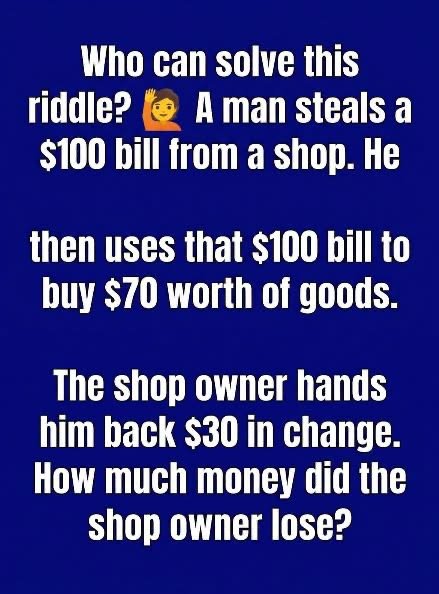
The original $100 bill simply changed hands during the transaction. Counting that same $100 again as an additional loss would mean counting the same money twice.
The Cash Flow in Simple Terms
Here’s another way to look at it:
Initial theft:
Shop loses $100 cash.
Purchase:
The stolen $100 returns to the cash register.
Change:
Shop gives the thief $30.
Merchandise:
Shop gives the thief $70 worth of goods.
Final loss:
$30 cash + $70 merchandise = $100.
Why Do People Get Different Answers?
The wording makes it tempting to add every number mentioned in the story.
Someone might reason:
$100 stolen + $70 merchandise + $30 change = $200
But that doesn’t work because the $70 and $30 together represent the $100 value that the thief ultimately walks away with. The original stolen bill isn’t an additional $100 loss on top of those items.
Another common thought is that the shop loses $130 because it loses the original $100 and then gives away $30.
Again, that double-counts the same transaction.
The cleanest method is to compare what the shop had before the theft with what it has after everything is finished.
The Easiest Way to Solve It
Imagine the shopkeeper starts with the $100 bill.
The thief takes it.
Then, during the purchase, that same bill comes back to the shop.
After the transaction, the thief leaves with $70 in merchandise and $30 in cash.
So the shopkeeper is ultimately missing:
$100 total.
The fact that the $100 bill temporarily returns to the cash register doesn’t erase the original theft. The thief simply converts the stolen cash into merchandise and change.
Final Answer: $100
The shopkeeper loses $100 altogether:
- $70 in merchandise
- $30 in cash
The $100 bill used for the purchase was the same money stolen at the beginning, so it should not be counted as a second $100 loss.
The Riddle’s Real Trick
This isn’t really a test of difficult arithmetic.
It’s a test of whether you can track the value of an object through several transactions without counting it twice.
Once you stop following the physical $100 bill and instead look at what the shopkeeper is missing at the end, the answer becomes much clearer.
$70 worth of goods + $30 change = $100 lost.
Sometimes the hardest part of a simple math riddle isn’t doing the calculation—it’s figuring out which numbers actually belong in the calculation.
