
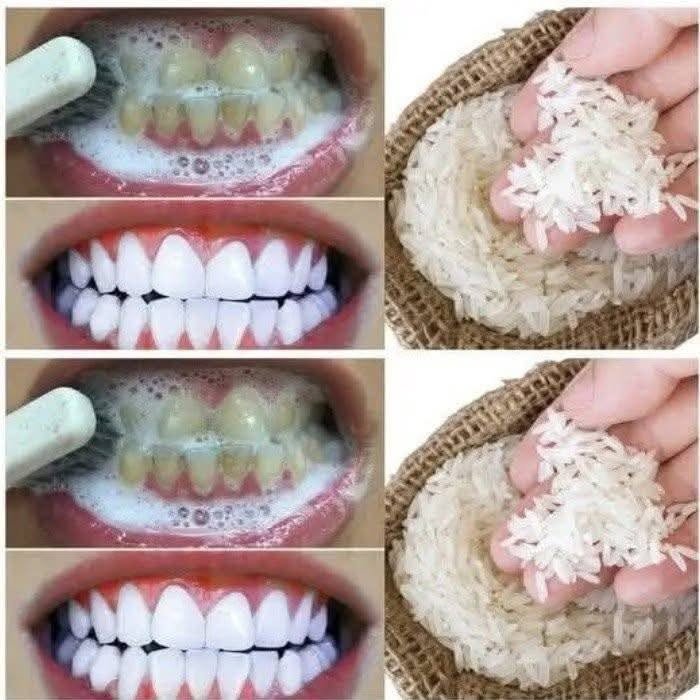
The “Rice Trick” Is Everywhere…
A little rice.
A little water.
One minute.
That’s all some viral posts claim you need to make your teeth look noticeably whiter.
It sounds almost too easy.
And that’s exactly why so many people are trying it.
But before you grab a bowl of rice and start scrubbing your teeth, there’s something important you should know:
Rice itself has not been established as a proven tooth-whitening treatment.
The idea has become popular online, but dental experts warn that many DIY whitening methods have little evidence behind them.
🦷 So Why Do People Think It Works?
The viral method usually involves rice water or finely ground rice being used around the teeth.
The theory is simple: rice particles may help remove some material sitting on the tooth surface.
And that sounds reasonable.
But removing surface debris is not the same thing as actually whitening the tooth.
Professional whitening works differently. Whitening products commonly use peroxide-based ingredients that can change the color of stains within the tooth structure.
That’s a very different process from simply rubbing something on the surface.
⚠️ The Part Viral Videos Don’t Show
Here’s where you need to be careful.
Your enamel isn’t something you want to aggressively scrub.
If a homemade mixture is too abrasive, repeated rubbing can wear down enamel.
And once enamel is lost, your body doesn’t simply grow it back.
The American Dental Association warns that overly abrasive DIY approaches can damage enamel and may even make teeth appear more yellow by exposing the naturally yellower dentin underneath.
So the goal shouldn’t be:
“How hard can I scrub?”
It should be:
“How can I keep my teeth clean without damaging them?”
⏱️ What About the “1-Minute” Claim?
This is another reason the trend is so appealing.
People love quick fixes.
One minute sounds perfect.
But there is no good evidence that brushing or rubbing rice on your teeth for one minute produces a clinically meaningful whitening effect.
A brighter-looking smile can come from removing some surface buildup or stains, but that’s not the same as bleaching the natural color of your teeth.
And if you’re repeatedly using a rough substance to chase a whiter appearance, you could end up doing more harm than good.
✨ Want a Brighter Smile? Start With the Basics
The boring answer is actually the safer one.
🪥 Brush Twice a Day
The ADA recommends brushing for two minutes, twice a day with fluoride toothpaste.
That’s much more useful for everyday oral care than experimenting with kitchen ingredients.
🧵 Clean Between Your Teeth
Food and plaque can collect between teeth where a toothbrush can’t reach effectively.
Cleaning between your teeth once a day is part of the ADA’s recommended routine.
☕ Watch Common Stain Sources
Coffee, tea, tobacco and some strongly colored foods can contribute to surface staining.
Reducing exposure can help your smile stay brighter.
😁 Choose Proven Whitening Products
If you specifically want whiter teeth, look for whitening products with evidence behind them and, where applicable, the ADA Seal of Acceptance.
The ADA recognizes certain whitening toothpastes and bleaching products that have been evaluated for safety and effectiveness.
🍚 Does That Mean Rice Is “Bad” for Your Teeth?
Not at all.
Eating rice is completely different from using rice as a whitening scrub.
Rice can be part of a normal balanced diet.
The problem is the claim that rice itself is a proven whitening treatment.
Right now, that claim goes beyond the available evidence.
There are scientific studies involving rice-based gels containing carbamide peroxide, but that’s very different from rubbing ordinary cooked rice or rice water on your teeth. Those experimental gels used an established bleaching ingredient—not rice alone—to produce the whitening effect.
🚫 Skip These Viral DIY Whitening Hacks
Be especially cautious with recipes involving:
Lemon or vinegar
Very abrasive powders
Charcoal scrubs
Strong homemade mixtures
Aggressive brushing
Unknown whitening recipes from social media
Natural doesn’t automatically mean safe.
Acidic ingredients can weaken enamel, while excessive abrasion can physically wear it away.
🦷 And Here’s the Real Secret…
Teeth don’t have to be perfectly white to be healthy.
Natural teeth come in different shades.
If your teeth suddenly become darker, develop unusual spots, or you notice pain, sensitivity or bleeding gums, that’s not a whitening problem you should try to solve with rice.
That’s a reason to talk to a dentist.
Sometimes discoloration is related to plaque, decay, gum problems, medications, trauma or the natural color of the tooth.
🌟 The Bottom Line
The rice whitening trend is interesting.
It’s cheap.
It’s simple.
And it takes almost no time.
But there’s no solid evidence that ordinary rice or rice water can whiten teeth in one minute.
If you want a brighter smile, don’t trade healthy enamel for a viral shortcut.
Brush properly.
Clean between your teeth.
Limit staining habits.
And if you want actual whitening, choose a method that has been properly tested.
Because when it comes to your smile, “natural” and “viral” aren’t the same thing as “proven.”
CONTINUED ON THE NEXT PAGE